
BOB DYLAN
MULLINS CENTER
UMASS-AMHERST
Friday, November 19, 2010
Review by Seth Rogovoy
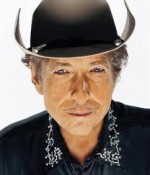 (AMHERST, Mass., November 19, 2010) – Bob Dylan is seemingly unstoppable. Merely a half-year away from his 70th birthday, he shows no sign of slowing down, still performing approximately 100 concerts per year as he has for the last two decades-plus. No one at his age or level of achievement has kept up a record such as this – he has truly become the Lou Gehrig of rock ‘n’ roll, as well as the voice of a generation and a prophet, mystic, and poet — yadda yadda yadda.
Even with hardly any singing voice left, as was the case at the Mullins Center on Friday night, Dylan has found a way to command a stage for two hours and keep an audience enthralled through his enigmatic charisma (or is it some formula of anti-charisma?), his remarkable body of songs from which to draw, and his mercurial, ever-changing musical arrangements, all of which he employs to find new meaning and immediacy in songs five, ten, twenty, thirty-five and in a few cases nearly fifty years old.
After steering his band and music toward some timeless blend of pre-rock, blues, folk, country, and early rock influences over the past 15 years of concerts in some seeming pursuit of a quintessential Americana roots sound, Dylan seems to have dispensed with much of it this time around in favor of a more unified, coherent aesthetic – a dark, noirish, spooky, almost Halloweenish style — that recontextualizes much of his work, putting it solidly in the prophetic mode that lends ballast to oft-sung lines from songs like “A Hard Rain’s a-Gonna Fall,” so that instead of sinking under the weight of its own legacy, it builds to a stupendous climax that sent a visceral wave of emotion through the crowd when he sang at the end:
And I’ll tell it and think it and speak it and breathe it
And reflect it from the mountain so all souls can see it
Then I’ll stand on the ocean until I start sinkin’
But I’ll know my song well before I start singin’
Indeed, this is exactly what he was doing, aided by his terrific band that, unlike in the past when it was employed to barrel through numbers with bluesy bluster and bravado, favored the subtle, minimalist touches that allowed every small phrase to count for even more. This approach was particularly effective in the hands of lead guitarist Charlie Sexton, who returned recently to Dylan’s band after more than a half-decade hiatus. Here, Sexton lent functional rhythm and harmonics to the songs, only adding about one phrase or riff per number for color or variation. But oh, when he played those phrases, they spoke nearly with as much power and glory as Dylan’s vocals. Which of course is how it’s supposed to be.
Working with a severerly constrained voice, Dylan himself used every tool and technique at his disposal to overcome those limitations and still get his message across. He did this through new, unique, or odd phrasing; through biting off lyrics or only pressing down on the key words of a phrase; through channeling the pure emotion – humor, rage, what have you – of a particular word, line, or song; and of course, through his musicianship.
Whereas for much of the past decade Dylan confined himself to behind his keyboards, this time out Dylan mixed things up throughout the evening, bouncing around from his organ (which, for the first time this reviewer ever noticed, could actually be heard – and what we heard was evocative playing that formed a latticework not unlike that of Al Kooper’s signature riffs on Dylan’s mid-1960s albums but more importantly, added to the haunting, post-blues quality of the arrangements) to his guitar front and center – including several well-played lead figures as well as chunky, loud, rhythmic riffs; and perhaps most surprisingly, singing several numbers crooner-style, into a hand-held mike, replete with gestures of his free hand and occasional recourse to a mouth harp. (For the full effect, view this wonderful video of the terrific stop-start arrangement, so typical of the overall approach of the evening, of the fan favorite, “Tangled Up in Blue.”
After years of relying heavily on pretty standard 12- and 16-bar blues arrangements for many of his songs (especially on recent recordings), even songs originally written in the country, rock or folk veins, Dylan has finally found his way to a kind of post-blues style all his own – a distant cousin of his mid-1960s metallic rock sound, but much darker and ominous. It still has blues DNA, but it’s all twisted and bent, forged with rockabilly more than the jump blues and swing styles he also favored in the early aughts, for an end result that sounds like something Quentin Tarantino might choose for his next soundtrack.
Even the stage setup seemed shaped to emphasize the darkness verging on claustrophobia; the dark gray drapery forming a room within which the band performed, and the back scrim serving as a screen for subtle projections – mostly vintage photographs of European arcades and such, but also the first introduction of live video of Dylan and his band – again, subtly, not like any Jumbotron, and very much in keeping with the flavor of the show.
Half of the songs from Dylan’s 16-song setlist were from his last four albums; the other half drawn from the early- to mid-1960s, a couple from the 1970s (including the funky, rocking opener, “Gonna Change My Way of Thinking”), and one from the late 1980s. All of the songs were in some way political and prophetic – “Thunder on the Mountain” evoking the sound and light show that greeted the Israelites when Moses ascended Mount Sinai (a metaphor, really, for a Bob Dylan concert); “Ballad of a Thin Man” no longer merely castigating a clueless chronicler or journalist, but rather an assembled crowd of Mr. Joneses (yes, each and every one of us) who have no idea what is happening here (or else, for example, how could we stand by and let our nation be taken over by wingnuts?).
Dylan sang of the disappointment of being a prophet without honor in “Honest With Me” (“Well I came ashore in the dead of the night/ Lot of things can get in the way when you’re tryin’ to do what’s right/ You don’t understand it — my feelings for you/ You’d be honest with me if only you knew”) and of the sense that judgment day has already begun in “Can’t Wait” (“It’s way past midnight and there are people all around/ Some on their way up, some on their way down/ The air burns and I’m trying to think straight/ And I don’t know how much longer I can wait.”) After he sang about his prophetic mission in the aforementioned “Hard Rain,” he retold the Biblical story of Abraham’s devotion to G-d in “Highway 61 Revisited,” which, like “Tangled Up in Blue,” built to a stunning crescendo that was as scary and chilling as it was dramatic and exciting.
That Dylan can still conjure up these sorts of moments and sustain this sort of mood night after night, over the course of two-hour long concerts, playing before multigenerational audiences and affecting new or casual listeners equally as well as hardened, nearly jaded loyalists, is just more to his credit. There is simply nothing else like a Bob Dylan concert, no one else like Bob Dylan. He truly is in a league of his own. The only league in which the beginning of the end of time, in Dylan’s words, is “mighty funny.” And the only league in which the singer, the player, the bandleader, is truly “like a rolling stone,” gathering no moss into his eighth decade.
Seth Rogovoy is Berkshire Living’s editor-in-chief and award-winning music critic, and the author of Bob Dylan: Prophet Mystic Poet.
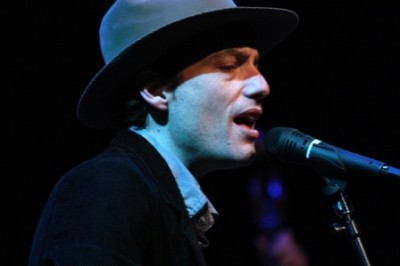 Cut to the chase: he played only one hit song by his “other” band, the Wallflowers: “Three Marlenas,” which fit in swimmingly with the rest of his set list, drawn entirely from Jakob Dylan’s two recent solo albums, 2008’s Seeing Things and this year’s Women + Country.
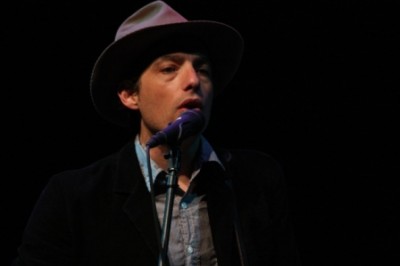 Then again, he doesn’t need to, because as Dylan matures – he turned 40 last December – he looks remarkably more like his father every day (check out the photos accompanying this review).
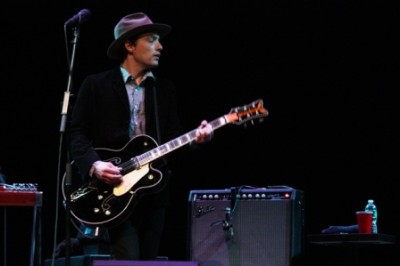 If not voluble, Dylan is certainly a more genial frontman than his enigmatic father, but he’s learned some lessons well, including how to stand motionless at a microphone to intone his haunting ballads and mid-tempo country-rockers about, well, women and country for the most part.